

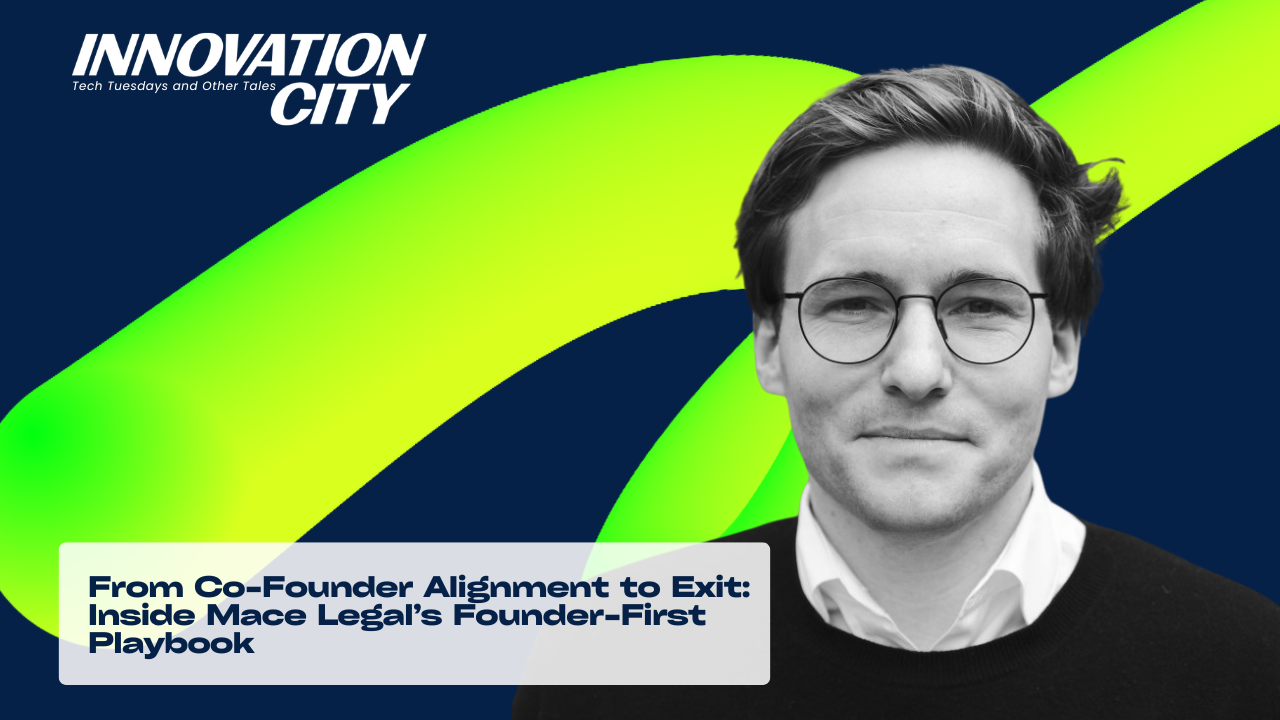
14 Jan From Co-Founder Alignment to Exit: Inside MACE Legal’s Founder-First Playbook
Most startup legal problems don’t start as legal problems. They start as misaligned expectations between co-founders, informal decisions made under pressure, or assumptions that “we’ll sort it out later.” By the time lawyers are brought in, those early choices are often expensive or impossible to undo!
Mace Legal works on the premise that founders are best supported when legal guidance starts early and stays close. In this Q&A, Ruben Schoenmaekers reflects on what changes when startup lawyers embed themselves inside founder ecosystems, the patterns he sees repeatedly across fast-growing companies, and why Cape Town (and Innovation City) now play a meaningful role in MACE Legal’s global approach.
Q: For readers who may not know Mace, how do you typically describe the firm and the founders you work with?
Mace is a boutique legal advisory firm and network focused on supporting founders, startups, and high-growth companies with strategic legal counsel. We were founded in 2022 and currently operate primarily out of Belgium and Denmark, with offices in Ghent and Copenhagen.
Our ambition is to become a global, founder-first firm, with South Africa forming an important part of that vision. We work closely with founders who are building ambitious companies and want legal partners who understand the realities of startup life, not just the paperwork.
Q: What core services do you focus on most today, and where are you seeing the greatest demand from founders?
Two areas stand out.
The first is venture capital transactions. We advise founders on early-stage funding rounds, from angel and seed investments through to venture funding, including cap tables, convertibles such as notes and SAFEs, shareholders’ agreements, and investment documentation.
The second is co-founder alignment, which is often underestimated. We support founders with co-founder fit, equity splits, and co-founder agreements. This led us to develop The Co-Founder Blueprint, a free legal tech tool designed to help co-founders align early and avoid the kinds of issues that can put a company at risk later on.
Q: How does your approach differ from more traditional legal firms working with startups?
We don’t just step in for transactions; we navigate founders from co-founder alignment all the way through to exit.
We work alongside founders over the long term and understand the pace, pressure, and ambiguity that come with building a startup. In short, we speak the startup language, in a founder dialect.
Q: What kind of work or support do you currently offer founders or companies connected to South Africa?
We’ve supported South African founders throughout their funding journeys by providing strategic legal guidance tailored to each stage of growth. This includes structuring cap tables, advising on convertibles, drafting shareholders’ and investment agreements, and supporting exits involving companies with South African links.
In addition, we regularly assist with co-founder alignments for teams either based in South Africa or preparing to raise international capital.
Q: Is your time in Cape Town mainly about serving existing clients, building new relationships, or deepening your understanding of the ecosystem?
It’s all of the above: We want to serve existing and new clients more closely, but we also have a clear ambition to find local lawyers or a partner law firm so that we can have permanent feet on the ground in South Africa. That process is ongoing, and spending time here is a crucial part of it.
Q: What are your goals for spending time in Cape Town each year, both commercially and strategically?
Spending time in Cape Town allows us to deepen relationships within the South African founder and investor ecosystem and to better support ambitious founders as they prepare for and execute international funding rounds.
From a business perspective, our goal is to build long-term partnerships with founders, operators, and investors, and to act as a trusted legal and strategic partner as companies scale beyond South Africa.
Q: When you’re embedded in an ecosystem like this, what legal issues tend to surface more clearly?
Co-founder misalignment surfaces much earlier and much more clearly.
What often starts as a personal or strategic issue quickly turns into legal risk. We frequently see unclear role allocation, informal equity splits, missing vesting arrangements, and the absence of proper leaver provisions. These issues usually become acute when a company starts raising capital or scaling, often when it’s already expensive and difficult to fix them.
Being embedded allows us to identify and address these risks before they become structural problems.
Q: You could work from almost anywhere. Why choose Cape Town, and why Innovation City specifically?
While we can technically work from anywhere, we choose Cape Town, and Innovation City in particular, because of the density and quality of the founder ecosystem it brings together.
Innovation City creates an environment where ambitious founders and operators interact daily. That proximity leads to deeper conversations about building, scaling, and structuring companies properly from day one.
We’ve already hosted fundraising workshops together at Innovation City, and the facilities and central location make it an ideal place to engage founders in a very practical way.
Q: Has this experience changed how you think about where and how Mace shows up globally?
Absolutely.
Our time at Innovation City has reinforced our belief that legal and strategic support works best when you’re embedded in local ecosystems. Being on the ground in South Africa has allowed us to support founders in a far more direct and practical way, and it has only strengthened our ambition to operate globally while staying close to where founders are building.
Get in touch with Ruben and the Mace team by emailing them at [email protected]