


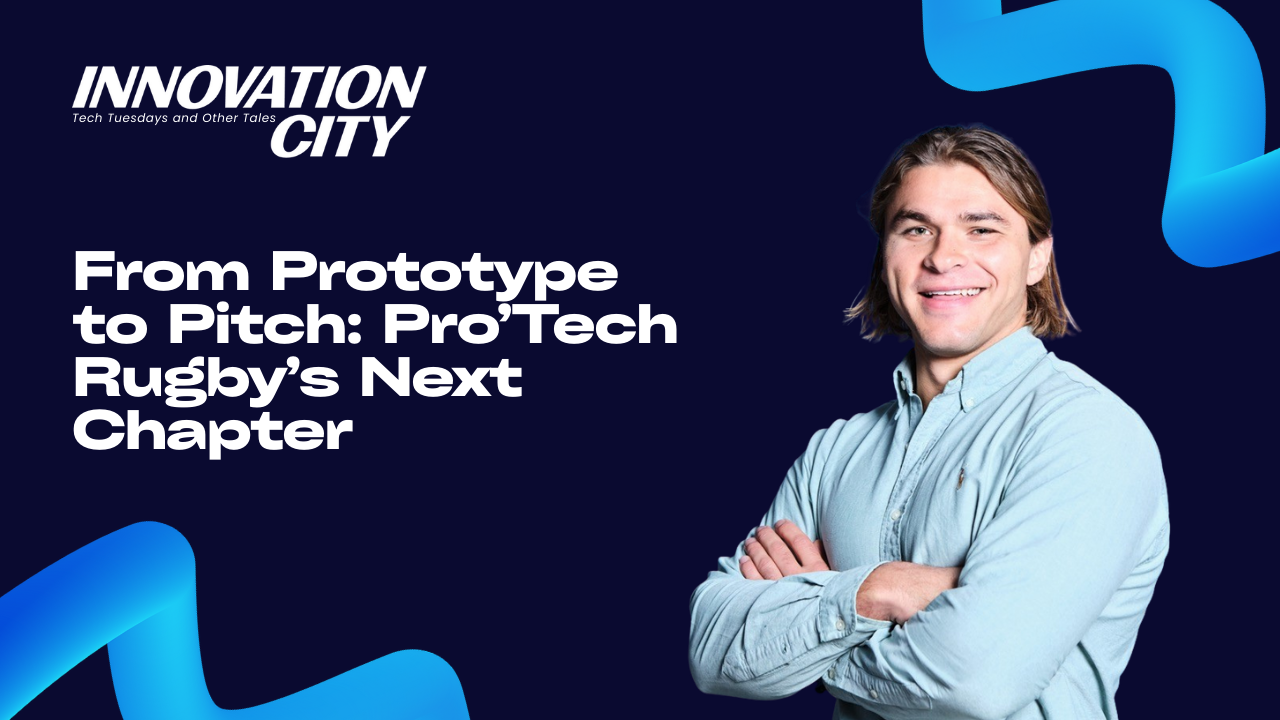
03 Feb From Prototype to Pitch: Pro’Tech Rugby’s Next Chapter
At Innovation City, we often get to see founders at the moment where ideas harden into execution. In our last feature of founder Marnus Coetsee and Pro’Tech Rugby, the company was still in deep exploration mode, questioning what real innovation in rugby safety could look like.
Fast forward to now, and Pro’Tech Rugby is entering a funding round with working prototypes, laboratory validation, patent filings underway, and a clear path toward elite deployment ahead of Rugby World Cup 2027.
In the Q&A below, Marnus shares where the business is right now, what’s changed since we last spoke, and why this raise marks a pivotal moment, not just for Pro’Tech Rugby, but for the future of player safety in contact sport.
Q: You’re entering a funding round. What moment is Pro’Tech Rugby at right now, and why is this the right time to raise?
We’ve reached the point where a re-imagined concept has been built, tested, and shown to work. We’ve gone from a blank page to real prototypes that outperform everything currently on the market. This round is about accelerating validation, locking in certification, and taking a product to market that will be worn by players in the lead-up to, and at, Rugby World Cup 2027. We know what needs to be built and why. Now it’s about execution.
Q: Since we last featured Pro’Tech Rugby, what has materially changed in the business or the product?
Pro’Tech Rugby has moved from early exploration into a clearly defined execution phase. We now have working prototypes that outperform all incumbent products in laboratory testing, a validated technical direction, and a clear roadmap to market. We’ve also built strong relationships across engineering, impact science, and rugby performance, bringing together a group of contributors who are helping us go deeper technically and move faster. The focus is now firmly on validation, compliance, and commercial readiness.
Q: What problem do people still underestimate when it comes to player safety, and how does Pro’Tech Rugby approach it differently?
People underestimate just how extreme the forces involved in rugby collisions really are. Incremental improvements to traditional foam-based designs simply aren’t enough to meaningfully change concussion risk. We recognised early on that this required a ground-up rethink. We started with a blank page, reimagined what a scrum cap could be, and engineered an entirely new approach. That meant deep engineering work, extensive experimentation, and testing. We’ve now implemented, built, and validated that approach, and the results show we’re onto something fundamentally different.
Q: Can you talk us through the validation journey so far and how testing has shaped the product?
We’ve followed a rigorous testing and benchmarking process using established protocols, including Rugby STAR-style testing. Our prototypes show significant reductions in key concussion-relevant metrics. Just as importantly, real-world feedback has shaped the product. If it doesn’t look good, feel good, breathe well, and allow players to hear and communicate, it won’t be worn. Performance and aesthetics have been engineered together from the start.
Q: What does success look like over the next 12–18 months if this round goes well?
Success means having a product on players’ heads that is demonstrably reducing concussion risk. That includes independent validation, progress through certification, and deployment with elite and high-performance programmes. Everything we are doing is geared toward being match-ready and visible by Rugby World Cup 2027.
Q: Rugby is global but highly traditional. How are you thinking about market entry and adoption across different regions?
Rugby is traditional, but it’s also highly connected globally. Influence spreads quickly once something gains credibility. While we’re initially focused on South Africa and the UK as key rugby markets, our primary focus is simply building the best possible product. If the product performs and players trust it, adoption follows quickly across regions.
Q: You’re filing patents in key rugby markets. What does your IP strategy protect, and why is it important at this stage?
Our IP protects what goes inside the scrum cap. It covers the technology and architecture that enables significantly greater concussion risk reduction than anything currently on the market. At this stage, protecting that advantage is critical because we’re not building a cosmetic product — we’re building a defensible technology platform.
Q: What kind of investor are you looking for at this point, beyond capital?
We’re looking for investors who genuinely care about rugby and player welfare. Ideally former international players or people with influence in the game who understand both performance and responsibility. This is more than a business for us. We’re on a mission to protect players and the sport we love.
Q: Hardware startups often face scale and manufacturing challenges. What have you learned so far?
We’ve been thinking about scale and manufacturability from the start. Physical products are hard to prototype and test, unlike software. To manage that, we run prototype iterations in parallel, work with strong global partners, and use the latest tools and processes to move quickly. It’s a global effort, with parts and prototypes moving fast. DHL Express has become an unexpectedly important part of the journey.
Q: As both an engineer and a rugby player, how do you balance technical precision with the realities of the game?
Rugby doesn’t tolerate compromise. If a product is uncomfortable, distracting, or changes how you play, it won’t be worn. So the engineering has to serve the rugby player first. My job is to maintain technical rigour while never losing sight of the fact that this needs to work for rugby players, in real matches, under real conditions.
Q: How do you see Pro’Tech Rugby contributing to the broader conversation around contact sports and long-term player health?
We are opening the door for real innovation in rugby safety. For too long the conversation has focused on awareness and diagnosis rather than meaningful risk reduction. By proving that concussion risk can be materially reduced within the laws of the game, we’re changing what’s considered achievable. Our goal is to raise the standard, push the market beyond incremental fixes, and encourage others to innovate. Rugby needs this shift to remain sustainable, and we intend to lead it.
Q: When you look back on this funding round in a year’s time, what would make you say it was the right raise?
If our product is on players’ heads and demonstrably reducing risk in one of the toughest sports in the world, it will have been the right raise. We’re doing that alongside a group of great people who genuinely care about the game and player welfare. Just as importantly, if a parent who was unsure about letting their child play rugby looks at what we’ve built and feels confident enough to say yes, that’s real impact.
Interested in getting involved in the raise? Email Marnus at [email protected]
Join Us: Founder Story with Marnus Coetsee
If you’d like to hear this story firsthand, beyond the lab results and into the lived reality of building a hardware startup in one of the world’s toughest sports, join us for the Pro’Tech Founder Story happening at Innovation City on the 5th of March!
This session will unpack the journey behind Pro’Tech Rugby: the engineering decisions, the validation process, the realities of scaling physical products, and what it takes to push meaningful innovation in a deeply traditional global sport. It’s a candid conversation for founders, investors, engineers, and anyone interested in how impact-driven companies are actually built.
Seats are limited. Get your ticket here.