
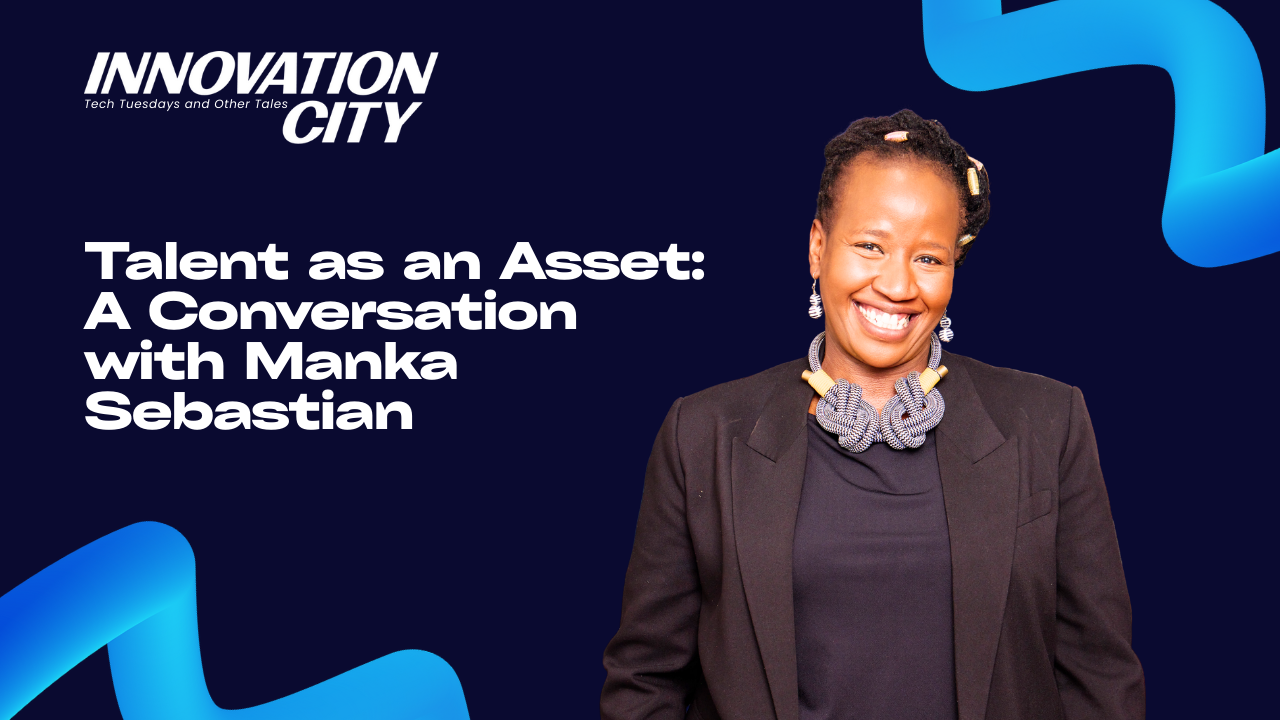
11 Feb Talent as an Asset: A Conversation with Manka Sebastian
Innovation City is the home of choice for the launch of the new Talent Hub, a collaborative initiative in partnership with the Swedish Consulate, Saab Grintek Defence, and Bitprop.
This important event (happening at IC on 11 Feb) brings together global and local voices to explore entrepreneurship, innovation, and talent development in Cape Town’s growing tech ecosystem, with speakers including Hans Otterling, Fredrik Jung Abbou, Prince Nwadeyi, and Kieno Kammies.
Moderating the roundtable discussion on entrepreneurship is Manka Sebastian, Director of EIT Group, who has spent over a decade developing and executing high-impact strategies focused on positive financial returns. With a background at Sanlam Investments and Bloomberg, she brings a perspective shaped by capital markets, data, and a deep curiosity about how talent, innovation, and impact intersect.
Ahead of the event, we asked Manka what she hopes to unpack in the conversation.
Q: What are you hoping to unpack in the discussion between venture capitalists and entrepreneurs?
In my asset management life, I’ve often dealt with the ‘cognitive dissonance’ investors face when looking at impact assets. There is acknowledgement that the value is there, but the traditional metrics often aren’t suited in translating that value in a way easily understood by traditional finance.
I want to unearth how we translate innovation and resilience into data. Prince Nwadeyi at Mustard Finance has achieved incredible 99.9% repayment rates in the informal sector by leveraging transaction data from wholesalers.
I would like to ask him and Hans Otterling, who is focused on replacing negative African narratives with data-driven success stories, how we can standardise this ‘impact data’ to make it digestible for global investment committees. How do we turn the ‘survivor market’ into a verifiable asset class that attracts the same level of confidence as a Nordic tech unicorn?
Q: What do investors in SA underestimate most about the local talent market?
Necessity is the mother of all invention! What investors underestimate and undervalue is the contextual intelligence that local talent has. When you couple that with the resilience that South Africans are known for, you have a melting pot of talent waiting to unlock investment opportunities that are long-term value generators.
African founders solve for constraints that Western founders are likely to never face, like data latency or payment fragmentation. This breeds a type of constrained creativity that is incredibly efficient. Investors underestimate that South Africa is not only competitive price wise; but are often also more adaptable because they’ve had to build robust systems in a low-resource environment. That ‘grit’ is a tangible asset class we aren’t valuing correctly.
Q: What do you think is most misunderstood about talent and recruitment in SA?
In development finance, we often look at structural inefficiencies. In the talent market, people often say South Africa has a ‘skills gap.’ I think that’s a misunderstanding. What we have is a ‘readiness gap.’
We have an abundance of raw, high-potential talent graduating from institutions. The bottleneck is the transition from academic theory to workplace impact. The Talent Hub is addressing this by focusing on this crucial nuance. Between the growth of Saab in search for engineers in anticipation of their exponential growth predicted until 2030, and Bitprop’s search for more generalised professionals, the investment in South African talent is aimed at contributing to shortening the readiness gap. We don’t need to import talent; we need to shorten the runway for our local youth to become productive. The misunderstanding is that the talent doesn’t exist; it does, it just needs the specific ‘learning paths’ to bridge that final step.
Additionally, we need to look past certifications and high academic results as the one true measure of potential success. In a world where AI is increasingly replacing desktop tasks, recruiting for a resilient growth mindset is becoming more important. We often react negatively to being called ‘the dark continent.’ In these times of AI, being from this ‘dark continent’ is the biggest strength of the African talent pool! The ideal candidate has to have contextual intelligence coupled with a resilient growth mindset. This candidate will outperform a cum laude candidate who is book smart and lacking these characteristics.
Q: As a recent addition to the board of Bitprop, which initiatives are you excited to guide in order to bolster Bitprop’s mission and vision, whilst also aligning with your personal passions and principles?
My personal passion lies in ‘bridging the gap’ between private sector capital and impactful infrastructure. At Bitprop, I am excited to guide the Audit and Risk Committee to ensure our governance structures are robust enough to withstand the scrutiny of top-tier institutional investors.
My goal is to guide Bitprop in building an Audit and Risk capability that gives institutional capital the same confidence investing in a backyard flat in Khayelitsha, as they would have in a CBD commercial development. We cannot scale impact without scaling trust.
Q: How can initiatives like the Talent Hub help turn early-career talent into future founders?
I am deeply interested in the multiplier effect of talent. We know that Hans Otterling witnessed the ‘Klarna Mafia’ phenomenon, where one decacorn spawned over 60 new startups founded by former employees.
My curiosity lies in the mechanics of that transfer. How do we structure this Talent Hub that we are launching so it isn’t just a training ground for recent graduates or future employees, but a launchpad for future founders? I want to ask the panel how we design ‘learning paths’ that don’t just teach technical skills, but also instill the ‘relentless ambition’ required to build the next Norrsken22 portfolio company. How do we turn today’s junior graduate/employee into tomorrow’s Series A founder?
Q: From your perspective, what do investors underestimate about how adaptable and globally ready South African talent really is?
There is a misconception that local talent can only build ‘local solutions.’ I think investors underestimate that solving for South Africa’s constraints actually prepares talent for the global majority.
Look at Saab: originally, a South African company was bought and integrated into a large Swedish company while retaining South African intellectual property. But crucially, due to the continued efforts of the South African team, Saab would need to scale continuously as it faces projected growth until 2035. Because our talent understands how to build low-cost, high-volume digital architectures for the mass market, they are more globally ready to serve the 80% of the world’s population in emerging markets, than a developer sitting in Silicon Valley. Our ‘contextual agility’ is a massive exportable asset.
Q: Why do ecosystems and platforms like the Talent Hub matter when it comes to building investor confidence in local talent?
As an impact professional focused on directing institutional funds towards high impact investment opportunities, one of my core thesis is that South African talent is one of the most mispriced assets on the global market; investors price it for ‘Emerging Market Risk’ but receive ‘Developed Market Delivery’ at a cost-quality ratio that drives significant margin expansion.
We must move beyond viewing Cape Town merely as a cost-arbitrage destination, offering developers at 60–80% lower rates than their Western counterparts, and recognise the alpha inherent in our workforce. The Talent Hub acts as critical social infrastructure (Capex) that corrects this pricing error by bridging the ‘Readiness Gap,’ into a verifiable, high-yield asset class for investors like Norrsken22.
As Cape Town continues to attract global interest, conversations like this one point to a bigger shift underway. The Talent Hub is not just about skills development; it’s about connecting capital, companies, and talent in a way that builds long-term value for the ecosystem.